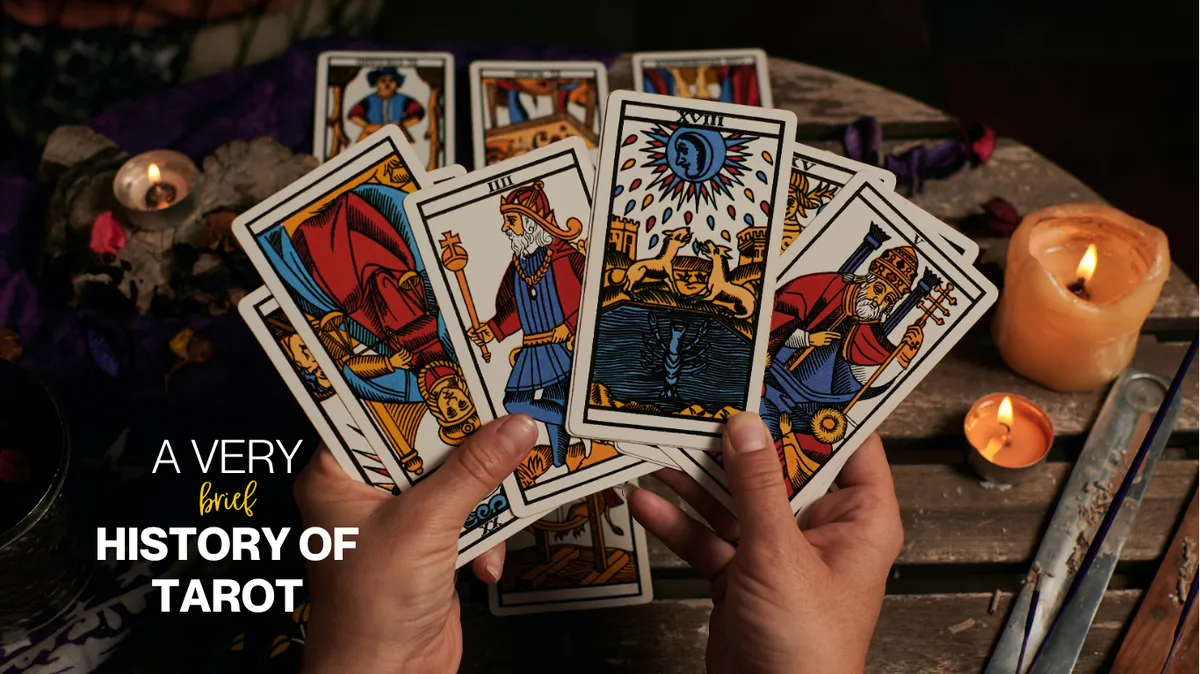
The briefest history I can give anyone on the Tarot is that no one truly knows for sure when it began to exist or who started it. There! You're all done reading.
The longer version is the subject of much debate in the occult and New Age communities, so let’s not bother with those worlds for now. Let’s slowly back away from arguments rooted in emotional attachments and parasocial relationships to popular New Age creators on TikTok and Instagram and the romantic notions of tradition they espouse, and instead look to what the historical record shows us.
The earliest Tarot cards that exist date to the late 1300s/early 1400s and were made in Italy and possibly France for prominent, wealthy families like the Visconti. Many scholars believe that the Major Arcana contain the lessons of the Cathars, a popular group of Christian mystics from medieval France who taught, among other things:
Naturally, the Church tried to slaughter them in the 1200s because the Cathars were wooing many people, particularly women, away from Catholicism. At the time of the Albigensian Crusade, they numbered over 3 million; they weren't a fringe movement.
It is known that some of the French Cathars escaped and went into hiding high in the most remote regions of the Pyrenees, but many more found a home in Lombardy, Italy. The Visconti family controlled the area and was sympathetic to the beliefs of the Italian Cathars. Even though Rome was the seat of power for Catholicism, Pope Innocent III, who had issued the death warrant for the Cathars, was not nearly as influential or popular in Italy as he was in France. This gave the Cathars a measure of safety. Their beliefs went underground and resurfaced 150 years later in the tapestries and cards of the weavers and cardmakers of Southern France.
The cardmakers ran themselves like a fraternal order or secret society. They kept both their papermaking methods and the secret meanings of the images they produced. This was at a time when the majority of Europe’s population, including many members of royal families, was illiterate, and much was passed down orally and guarded. The Albigensian Crusade and Inquisition had destroyed almost all of the material culture of the Cathars and anyone else who disagreed with the Church. This was still fresh in Europe's cultural memory when cards first began to appear. The introduction of mass papermaking methods towards the end of the 1200s meant that information could be taught to illiterate seekers in a less cumbersome way than dragging around illustrated tapestries or bringing people to rooms painted from floor to ceiling with stories. Educational images could be replicated faster, more affordably, and made portable.
The Cathars themselves did not use cards. Playing cards did not arrive in Europe until the 1300s, well after the death of the last known Cathar. These cards came through international trade routes from the Middle East and other parts of Asia, where card games were popular entertainment. Apart from being used in group gaming, they also contained symbolic images that could be used in a contemplative, spiritual way. Naturally, the Church condemned their use, which made them even more popular.
The idea of fortune-telling with cards was first documented in the book “Triumpho di Fortuna” by the Italian author Sigismondo Fanti in the early 16th century. For him to have written this, cartomancy must most likely have been an established practice in the Mediterranean, if not elsewhere in Europe.
There isn’t a direct trail in history that allows us to follow the development of the Tarot as we know it, from the late 1300s onward. Divination was an underground practice that carried punishment, well into the modern age. Although they could be mass-produced via block printing, the cards were not affordable for everyone who might want them; access was still largely limited to the upper-middle and wealthy classes. Occult meanings were not shared with just anyone, and those who knew how to read the cards kept their heads down.
While the cardmakers may have run themselves like a secret society and used Tarot to hide secrets in plain sight, they were still subject to the watchful eye of the elites and rulers of the day. It is no secret that throughout history, the wealthy have gatekept beliefs and practices that were labelled “witchcraft,” “demonic,” or “evil” because they worked and helped them amass wealth and power. It was to their advantage to keep commoners ignorant.
In the 1600s, this began to change as the French government took a different tack. Rather than preventing common people from accessing the Tarot, which had always been publicly promoted as a card game, they took advantage of the interest in cards and taxed them, using the cards as a reliable source of revenue for the country. They tightly regulated the cardmakers, down to the paper and ink used to make the cards. These controlled guilds were abolished for a brief period during the French Revolution, which allowed cardmakers to experiment with design, but were then reinstated by Napoleon.
According to one of the last cardmakers of France, the late Jean-Claude Flornoy (1950-2011), Tarot cards appeared “seemingly out of nowhere” in 1375 in the Lombardy region of Northern Italy. On the purpose of the Tarot, he wrote, “one of the essential aims of compagnonnage and of all medieval spirituality: to cross during one’s lifetime into the other world of reality. Once the 16th century came to an end, it seems that the teachings and paths leading to this experience were lost and that only the tarot retain [sic] their memory.” He referred to this journey as the pèlerinage de l’âme, or pilgrimage of the soul. The Fool is the pilgrim having an experience through the other Major Arcana cards.
The Marseille Tarot of France is not a specific deck but a style of Tarot. In the 1800s, historians and antiquarians created this term to distinguish the cards from other tarot decks being sold and traded. Once the occult revival became a commercial movement in the 1800s, everyone was selling a system, and just like now, you had to sift through it all.
In 1781, occultist Antoine Court de Gebelin published Volume VIII of “Monde Primitif”. This book contains essays linking the Tarot to the Hebrew alphabet and initiatory mysteries of ancient Egypt. Despite a complete lack of evidence to support this and considerable evidence pointing to the Tarot as European in origin and to Cathar teachings meant to be accessible to everyone, his writings stuck, and the myths began. In 1783, the occultist Etteilla published “How to Entertain oneself with a Pack of Cards called Tarot.” This was the first “how-to” guide and contained an elaborate story of the Tarot’s “ancient Egyptian” origins.
In 1804, a follower of Etteilla called D’Odoucet published a book on card meanings. It was based on Etteilla’s work and formed the basis for about half of the meanings in the Rider-Waite-Smith Tarot deck published in 1909.
In 1856, Eliphas Levi published a book, “Dogma and Ritual of Transcendental Magic.” This writing concerns Western occult “high magical” traditions. It raised the perception of Tarot away from something for the masses, giving it an important place in ceremonialism.
Let’s skip forward a few decades! In 1888, S.L. MacGregor Mathers and William Westcott obtained Book T and Cypher Manuscript, two books written by occultist Kenneth MacKenzie, a student of Levi’s. These two documents formed the basis of the Hermetic Order of the Golden Dawn. That same year, Mathers also published “The Tarot: Its Occult Signification, Use in Fortune Telling, and Method of Play.” Also, that same year, Ely Star published an astrology book, showcasing Tarot using card names created by Paul Christian. In 1889, Papus published the “Tarot of Bohemians,” which codified Levi’s teachings on Tarot. The Marseille Tarot and Oswald Wirth decks were used to illustrate it.
In 1907, the British Museum exhibited photographs of the Sola Busca Tarot to the public. This deck was created in 1491 in Italy. Pamela Coleman Smith was the artist commissioned to illustrate the cards now known as the Rider-Waite-Smith Tarot, or RWS Tarot. She copied several of the Sola Busca Minor Arcana images for inclusion in the RWS Tarot. Nothing is new!
In 1909, Rider Publishing released The Rider Tarot. Over the years, the title has been amended to “Rider Waite” and most recently to “Rider Waite Smith,” acknowledging the contribution of artist Pamela Coleman Smith. This deck became the foundation of the modern use of Tarot cards and, along with the Golden Dawn’s teachings, heavily influenced the “ancient” witchcraft and magical practices described over the last several decades.
This has spawned several versions of the Tarot over the last several decades. Several modern mystery schools have since based their teachings on supposed ancient beliefs and practices that were grafted onto the Tarot cards in the late 1700s. For many years, I avoided mentioning Hebrew letters and Kaballah for these reasons. These days, I mention them carefully now and then because they have become part of the accepted canon of modern Tarot.
On its own, the Marseille Tarot reflects a system of mysticism and magic that can help someone shift their energy. Sacred geometry, astrology, and arithmancy were worked into the symbolism and passed on from artisan to artisan. As an arithmancer, this is why I work with this particular deck.
For more information about all of this, I highly encourage seekers to check out the following resources:
Flornoy, J. C. (2018). Seeing the World - Tarot Signposts on the Path to Perception (D. Vine, Trans.). Editions LeTarot.com.
Houdouin, W. (2023). THE SACRED CODE OF TAROT: The Rediscovery Of The Original Nature Of The Marseille Tarot (2nd ed.). Lulu.
Jodorowski, A., & Costa, M. (2009). The Way of Tarot: The Spiritual Teacher in the Cards. Destiny Books.
Sturgess, R. A. (2020). The Spiritual Roots of the Tarot: The Cathar Code Hidden in the Cards. Inner Traditions International.